On church authority, and the question that divides Rome from the Orthodox East

Many people who are drawn back toward historic, sacramental Christianity — the liturgy, the sacraments, the company of the saints, a faith that is received rather than invented — arrive at a particular hesitation. They find they can accept, even want, the things a low-church upbringing taught them to distrust: real structure, authoritative teaching, a priesthood in genuine succession, Scripture handed on rather than improvised. And yet they stop before one specific claim — that final authority rests in a single universal head, the Bishop of Rome, with the conformity that follows from it.
This essay tries to map that question fairly: what it actually turns on, the strongest case each side makes, the honest difficulties on both, and a few things worth knowing before going looking. It does not deliver a verdict. The aim is only to make the question clear enough to be wrestled with honestly rather than settled by instinct.
Where the question actually sits
The first move is to notice how much is decided the moment a person grants that Scripture must be read inside a living Tradition — taught with authority, guarded by a priesthood, not left to each believer’s private judgment. That single concession steps away from the whole low-church Protestant model: sola scriptura, the individual conscience as final court, every reader his own interpreter. To grant it is to choose structure.
So the live question is no longer structure or freedom. That has already been answered in favour of structure. What remains is narrower and sharper: which structure — and above all, what kind of authority sits at its summit. Is there one chair in which the buck finally stops, or is authority held by the whole body and exercised through councils? That single question is the fault line between the Catholic West and the Orthodox East. Almost everything else follows from it.
To want the apostolic, sacramental, taught faith is already to have chosen structure. The only question left is where its final authority lies.
The actual disagreement
For roughly the first thousand years there was one Church, governed conciliarly through the great ecumenical councils, with five ancient sees of honour — Rome, Constantinople, Alexandria, Antioch, Jerusalem. Rome held a primacy, but the modern Roman claim — universal jurisdiction over every bishop, and the power to define doctrine infallibly — was not yet what it later became. The estrangement between East and West was slow; the mutual excommunications of 1054 are the convenient marker, but the real parting took centuries of drift in language, politics, and theology.
Two issues recur at the centre of it:
- The Filioque. The Western Church added the words “and the Son” to the Nicene Creed, describing the procession of the Holy Spirit. The East objected to the theology, but at least as much to the act itself: no single see, on its own authority, may alter a Creed that belongs to the whole Church. This is the procedural heart of the entire dispute — who has the right to change what is held in common?
- Papal supremacy and infallibility. A primacy of honour, “first among equals,” versus a universal jurisdiction with the authority to teach infallibly. Rome’s fullest form of this claim was formally defined at the First Vatican Council in 1870.
Everything else — purgatory, the precise dogmas about the Virgin Mary, the use of unleavened bread, the calendar — tends to come back to that one question of who may decide, and on whose authority.

The Catholic case, at its strongest
Christ gives Peter the keys and says, “on this rock I will build my Church” (Matthew 16); the Petrine office, on this reading, continues in the Bishop of Rome. A visible Church needs a visible principle of unity — a point at which questions can finally be answered rather than argued in perpetuity. Doctrine genuinely develops, as John Henry Newman argued: the acorn becomes the oak without ceasing to be the same tree, so later definitions are not additions but the unfolding of what was always implicit. Infallibility, properly understood, is defined narrowly — engaged only when the pope teaches ex cathedra on faith and morals, which has been invoked explicitly only a couple of times — and it concerns the indefectibility of the Church’s teaching, not the personal holiness of any given pope. The corrupt popes of history therefore do not disprove the office. And the fruit is real: Rome can convene, decide, and speak to the modern world with a coherence that looser bodies struggle to match.
The Orthodox case, at its strongest
The Church of the first millennium was conciliar, and Rome’s primacy was one of honour, not jurisdiction. Authority belongs to the whole Body, guided by the Holy Spirit and expressed through councils that are then received by the faithful — what the East calls the mind of the Church. On this view the disputed Roman doctrines (the Filioque, papal infallibility, certain Marian definitions) are precisely the later innovations that a single see had no right to impose on everyone else. There is also a structural intuition with real force: a supreme apex is the one office that no council can correct, and that is exactly where unaccountable power, and therefore corruption and abuse, tends to concentrate. Better a hierarchy with a ceiling of accountability above it than a throne with nothing above it at all.
The honest difficulties, on both sides
A fair account has to name the weaknesses of each position, not only the strengths.
For the East: the very absence of a final arbiter that makes the Orthodox model attractive also means disputes can fester unresolved. The rupture between the Patriarchates of Moscow and Constantinople over Ukraine (2018–19) divided world Orthodoxy; a long-planned pan-Orthodox council in Crete (2016) was boycotted by several churches; and phyletism — the fusion of the Church with ethnic nationalism — was formally condemned as a heresy in 1872 and remains very much alive. The Catholic critique bites here: a body with no head can struggle to act, or even to speak, as one.
For Rome: the doctrine of development is powerful but double-edged, because to its critics it can look indistinguishable from simply adding new things and calling them ancient. And the concentration of authority that produces coherence is the same concentration that history shows can be gravely abused, with no structural remedy above it. The reassurance that “the office is not the man” is cold comfort to those harmed when the office shields the man.
Neither side is without its embarrassments. Choosing between them honestly means weighing live trade-offs, not picking the one with no problems.
On structure and rigour
It is a common mistake to imagine the Orthodox East as somehow “lighter” or less demanding because it lacks a single supreme head. In practice the opposite is often true: Orthodoxy tends to be more ascetically and canonically demanding — long and frequent fasting, lengthy liturgies, serious penitential discipline. The difference is not less structure. It is a different shape of authority: distributed across the bishops, the councils, and the whole praying body that receives their decisions, rather than gathered into one chair. Anyone attracted to the East for a sense of freedom should expect to find, instead, a tradition that asks a great deal.
A note on “Celtic” Christianity
Anyone exploring this territory in Britain or Ireland will sooner or later meet the words “Celtic Christianity” and “Celtic Orthodox,” and both deserve care.
The romantic picture — a free, nature-loving Celtic church standing apart from a domineering Rome — is largely a later construction, much of it nineteenth- and twentieth-century, and some of it closer to modern spiritual fashion than to the historical record. The early British and Irish Church was in communion with Rome; its famous distinctives, such as the dating of Easter and the style of monastic tonsure, were matters of practice and organisation, and were largely settled at the Synod of Whitby in 664 in Rome’s favour. There was no separate “Celtic Church” with a rival ecclesiology or a rejection of the papacy.
Underneath the romance, however, lies something solid. The great early saints of these islands — Ninian, Columba, Cuthbert, Aidan, Brigid and the rest — lived before the Great Schism, in the one undivided Church. They belong to the whole of it. The Orthodox East can venerate them as Orthodox saints with the same right that the Catholic West venerates them as Catholic ones, precisely because they predate the division. That is a shared inheritance, not an appropriation by either party.

There is also a genuine fork in the name worth knowing about. An independent body exists that calls itself “the Celtic Orthodox Church,” with roots in Brittany and an older British-Orthodox lineage; it is not in communion with the canonical Orthodox Churches. This is quite distinct from canonical Eastern Orthodox communities that simply honour the Celtic saints. The distinction matters enormously for the authority question this essay is about: one is inside the apostolic communion, the other outside it.
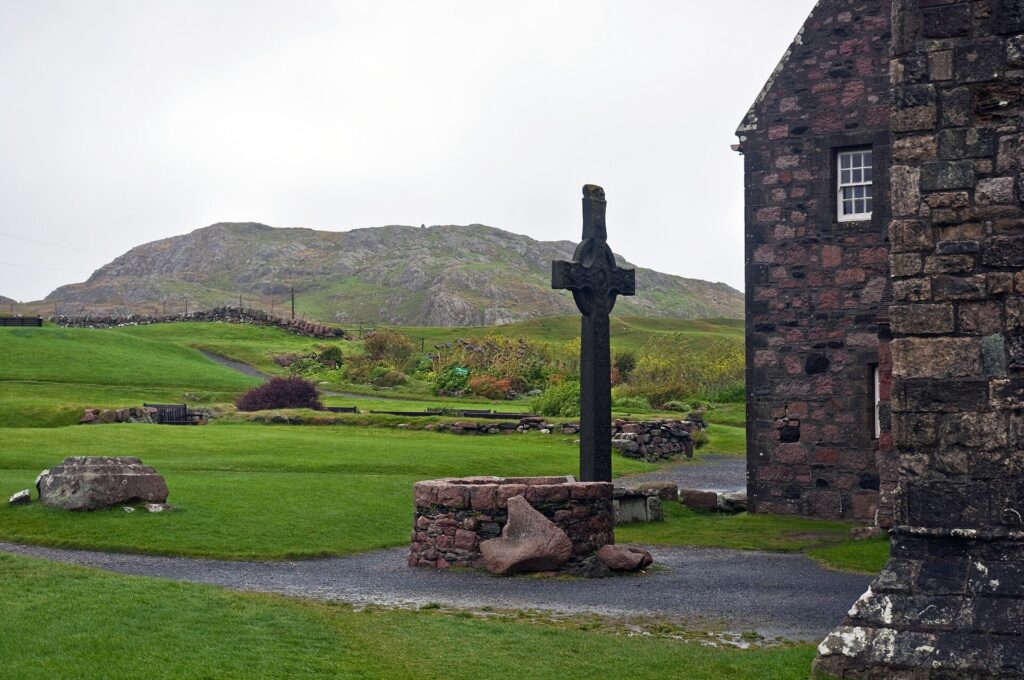
A concrete example makes the difference clear. The Monastery of All Celtic Saints at Kilninian on the Isle of Mull — founded in 2010, with a sister community on Iona — is fully canonical Eastern Orthodox, under the Romanian Orthodox Archdiocese of Western Europe, its sanctuary consecrated in 2024. It is English-speaking and multinational: mainstream Orthodoxy that has deliberately taken up the pre-Schism saints of these islands as its own, not a fringe jurisdiction trading on a Celtic name. The practical lesson generalises: where a community wears the “Celtic” label, the first question to ask is simply whether it stands inside the canonical communion or outside it.
Questions worth sitting with
The honest questions cut in both directions:
- Is a “primacy of honour” actually coherent, or does honour without function quietly collapse — does someone, somewhere, eventually need to be able to say the final word?
- Can a Church with no final arbiter give clear answers to the genuinely new questions of the age, or is its silence sometimes inability dressed as restraint?
- Is it sustainable to participate indefinitely in a Church whose central claims one rejects, or does the altar eventually require a plain yes or no?
- And underneath all of it: does a person decline papal authority because they have weighed it and found it wanting, or because submission of any kind is instinctively resisted? The two can wear the same face, and the difference is worth real watchfulness — it is the place where a genuine conviction and an old wound are easiest to confuse.
Where this leaves the inquiry
Not at an answer, but at a sharper question — which is its own kind of progress. The territory, once mapped, is fairly clear: to want the apostolic, sacramental, taught faith is already to have chosen structure; the remaining decision is between two ancient forms of it, divided chiefly over where final authority lies. Both have real strength and real difficulty. Neither is the effortless option.
For going deeper
Kallistos Ware, The Orthodox Way and The Orthodox Church — written by an Englishman who travelled this exact road, and the natural introduction. A. Edward Siecienski, The Papacy and the Orthodox — the central question argued carefully and fairly. And, for the Catholic position at its best, John Henry Newman, An Essay on the Development of Christian Doctrine.
A question of this weight is rarely answered alone, and rarely answered quickly. Tested honestly, in good company, over time — that is itself the safeguard. Iron sharpens iron.
Leave a Reply